 Amy Marietta
Best Lash Cluster Brands for Sensitive Eyes
Sensitive eyes deserve more than a “fingers crossed” approach to lash shopping. Most lash cluster brands for sensitive eyes get the aesthetics right but miss the part that actually matters: adhesive ingredients that won’t trigger a reaction by lunch. The real challenge is that “hypoallergenic” on a label means almost nothing without a standardized definition behind it. After reviewing dozens of options across ingredient transparency, cluster weight, adhesive safety, and what people actually report when they use these products, this guide breaks down the five brands worth your attention.
The vetting process for this list
Every brand on this list was evaluated using publicly available information pulled from official websites, beauty review platforms, and documented feedback from real users. The focus stayed on brands with a clear track record in the lash space, particularly around how open they are about ingredients, wear comfort, and how they actually perform for people with sensitive eyes.
→ See the full research breakdown
- Lilac St. – Best for DIY eyelash extensions and cruelty-free beauty products
- TAD Beauty – Best for DIY at-home lash extensions
- Model Rock – Best for premium false eyelashes and cruelty-free cosmetics
- Elour Lashes – Best for wholesale lash manufacturing, beauty brand OEM/ODM services, global cosmetics distribution
- Lash Beauty Pro – Best for eyelash salon wholesale and private label branding
The Difference the Right Lash Cluster Brands For Sensitive Eyes Makes
Choosing the wrong lash cluster brand is not just a bad beauty day. It can mean swollen eyelids, irritated corneas, or a contact lens wearer spending their afternoon at urgent care.
The adhesive is usually where things go wrong. Formaldehyde-releasing preservatives and latex-based bonding agents show up in more lash glues than most people realize, and they’re not always disclosed clearly on the packaging.
Cluster weight matters just as much. Heavy clusters pull on delicate lashes and strain already-sensitive eyelids, especially for anyone managing dry eye or post-procedure sensitivity.
Brands that get this right tend to share a few things: full ingredient transparency, lightweight cluster construction, and adhesives tested against eye-safe wear standards.
The payoff shows up in real metrics. Lower irritation rates, adhesive bonds that hold comfortably through a full day without needing harsh removers, and clusters that can be reused without falling apart. That kind of performance is rare, and it’s exactly what separates a well-chosen brand from a regrettable one.
The 5 Best Lash Cluster Brands For Sensitive Eyes: Quick Comparison
Note: All data in this table is sourced from review platforms and the official websites of the listed companies.
| Company Name | Years Operating | Headquartered In |
| Lilac St. | Est. 2020 | Seattle, Washington |
| TAD Beauty | Est. 2024 | Sparks, NV |
| Model Rock | Est. 2012 | Woy Woy, New South Wales, Australia |
| Elour Lashes | Est. 2005 | Qingdao, China |
| Lash Beauty Pro | Not disclosed | China |
-
Lilac St. – Best for DIY Lash Extensions With Cruelty-Free Ingredients
What Is Lilac St.’s Business?
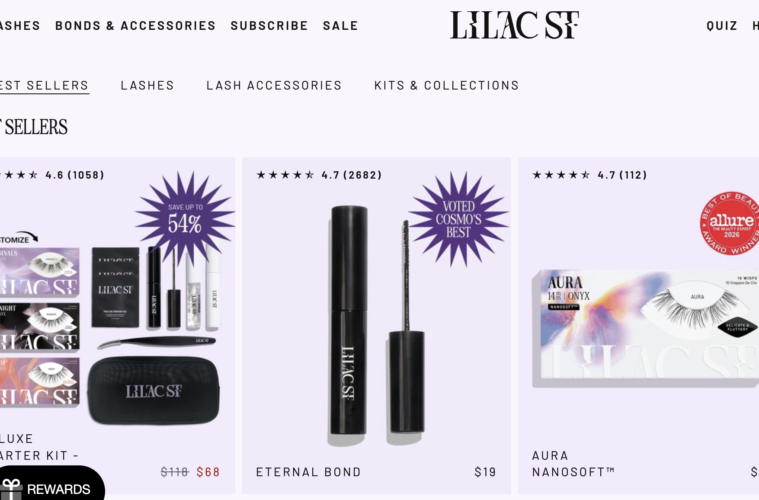
Lilac St. is a Seattle-based beauty brand focused on DIY eyelash extension kits designed for at-home use. Founded in 2020 by Alicia Zeng in San Francisco, the brand grew out of pandemic-era salon closures and scaled to 10x revenue in its first year without outside funding. Their kits use Korean silk lashes and flexible cotton thread, keeping cluster weight low. Every product is vegan and cruelty-free, and the line includes lash glue, applicators, mirrors, and travel bags built around the full DIY experience.
What’s Lilac St.’s Edge in Lash Cluster Brands For Sensitive Eyes?
Lilac St. addresses one of the most frustrating gaps in the DIY lash space: clusters that look professional but feel heavy and pull on natural lashes by the end of the day. Their Korean silk construction keeps clusters light, and the flexible cotton thread base sits comfortably against the lash line without digging into sensitive eyelids.
From the User Reviews:
Lilac St. has collected over 10,000 verified product reviews, which is a meaningful signal for a brand that’s only been around since 2020. The real story in those reviews is repeat customers: the brand hit 82% year-over-year growth in repeat buyers, meaning people aren’t just trying it once. That kind of retention (not cheap to earn, by the way) suggests the products are actually delivering on comfort and longevity.
-
TAD Beauty – Best for 3D-Printed DIY Lash Extensions
What Is TAD Beauty’s Business?
TAD Beauty is a newer brand, founded in 2024, built around what they call the world’s first 3D-printed DIY lashes. The founder, Michelle Nguyen, brings over 18 years of lash industry experience and previously helped scale a professional lash brand to $30 million annually. TAD Beauty’s main product uses proprietary 3D Memory Flex Technology, which holds curl and shape over time without traditional band construction. Their microstructure design is built for at-home application, aiming to close the gap between salon-quality results and DIY accessibility.
What’s TAD Beauty’s Edge in Lash Cluster Brands For Sensitive Eyes?
TAD Beauty tackles the fit-and-comfort problem at the manufacturing level, using 3D-printed construction to create clusters with a more precise grip profile than standard hand-crafted options. For sensitive-eyelid users, that precision matters because an ill-fitting cluster shifts throughout the day and increases friction against delicate skin.
From the User Reviews:
TAD Beauty is early-stage, so the public review pool is still building. The founder’s background carries a lot of the credibility here, since 18 years in the professional lash industry isn’t a small credential. From what’s available, the technology-forward positioning is resonating with DIY lash enthusiasts who’ve been disappointed by cluster options that look good on arrival but don’t hold up through a full day of wear.
-
Model Rock – Best for Premium Hand-Crafted False Lashes
What Is Model Rock’s Business?
Model Rock is an Australian family-owned lash brand founded in 2012 by Raelene and Jeremy. The company makes premium false eyelashes from 100% natural human hair using hand-crafted construction. They’re fully cruelty-free and vegan, which is a real commitment given the human hair sourcing considerations involved. Beyond lashes, they’ve expanded into liquid-to-matte lip products. They also run a stockist program for beauty professionals and ship same-day on weekdays, which puts them ahead of many competitors on fulfillment speed.
What’s Model Rock’s Edge in Lash Cluster Brands For Sensitive Eyes?
Model Rock’s hand-crafted construction means each cluster is built with attention to weight distribution, which directly affects how much strain gets placed on sensitive eyelids during wear. Natural human hair lashes also tend to sit and move more like natural lashes, reducing the foreign-body sensation that often triggers irritation in sensitivity-prone users.
From the User Reviews:
Model Rock’s public review presence reflects a brand that’s been building quietly since 2012. Consistent themes across customer feedback point to quality that justifies the price, and the same-day dispatch gets specific praise from buyers who’ve been burned by slow shipping from competitors. That kind of detail (logistical, not glamorous) matters when you’re building a repeat customer base.
-
Elour Lashes – Best for Wholesale Lash Manufacturing and OEM Services
What Is Elour Lashes’ Business?
Elour Lashes is a Qingdao-based manufacturer that has been producing eyelashes since 2005. Their factory covers 2,000 square meters and outputs around 2 million pairs per month, supplying over 3,000 brands across 50+ countries. The product range runs past 1,000 styles, covering 3D, 5D, and 6D mink lashes, faux mink, silk, human hair, and synthetic options. They specialize in OEM and ODM services, including custom lash designs, private label packaging, and branded products. Certifications from SGS, INTERTEK, and DGM back the manufacturing standards.
What’s Elour Lashes’ Edge in Lash Cluster Brands For Sensitive Eyes?
Elour Lashes gives beauty brands access to a full material library, which means brands sourcing clusters for sensitive-eye consumers can spec exactly what they need at the fiber level rather than accepting a standard off-the-shelf product. That material control is where a lot of irritation problems get solved before they reach the end consumer.
From the User Reviews:
Elour Lashes operates primarily in the B2B space, so the feedback picture looks different from a direct-to-consumer brand. The numbers do the talking here: 3,000+ brands sourcing from one factory across 50+ countries is a supply chain trust signal that’s hard to fake. Long-term brand partnerships are the norm rather than one-off orders, which points to consistent manufacturing quality over time.
-
Lash Beauty Pro – Best for Salon Wholesale and Private Label Branding
What Is Lash Beauty Pro’s Business?
Lash Beauty Pro is a China-based wholesale manufacturer serving lash salons, studios, and lash stores globally. Their product lines cover professional eyelash extensions, DIY cluster lash extensions, tools, equipment, and salon furniture. The lash fibers are made from PBT and produced without animal testing. Their liquids, including adhesives, are manufactured in Korea, which is a meaningful detail since Korean lash adhesive production has a strong reputation for quality standards. They offer OEM and ODM customization alongside private label services, with multilingual support and multiple payment options built in for international clients.
What’s Lash Beauty Pro’s Edge in Lash Cluster Brands For Sensitive Eyes?
Lash Beauty Pro’s Korea-sourced adhesives address one of the more overlooked risks in the cluster lash space: adhesive formulas that haven’t been through rigorous eye-safety testing. For salon owners building a sensitive-eye clientele, the adhesive supply chain matters as much as the fiber quality.
From the User Reviews:
Customer feedback highlights two things consistently: competitive pricing and reliable order fulfillment for customized products. Long-term partnerships going back to at least 2019 are common, which suggests the brand earns repeat business rather than just first-time trial orders. That kind of documented loyalty across international clients is the real proof of a wholesale supplier worth trusting.
The Process Behind This Ranking
Building this list started with a broad look at the lash cluster category, filtered through the lens of sensitive-eye safety. The process wasn’t about finding the most popular brands. It was about finding brands where ingredient transparency, adhesive safety, and cluster construction were clearly prioritized.
Data Requirements and Collection Methods
The initial longlist was assembled by pulling from multiple sources simultaneously. Beauty-specific directories, professional lash forums, cosmetics-focused review platforms, and brand websites were all reviewed together to build a picture of which names kept appearing in sensitive-eye conversations. Brands that appeared only in paid placement contexts without organic community mention were deprioritized early. The goal was a longlist grounded in what real buyers and professionals were actually recommending.
Pre-Verification Phase
Before any brand made it past the longlist, a round of filtering removed options that lacked verifiable information. Brands with no documented customer feedback, no clear ingredient disclosure practices, or no visible track record in the beauty space were cut. Review pattern analysis also happened here: sudden spikes in suspiciously similar five-star reviews were flagged, and brands relying heavily on that kind of manufactured social proof didn’t move forward.
The Verification Phase
Each remaining brand was cross-checked by comparing what their official websites claimed against what appeared in third-party reviews and community discussions. Where a brand claimed “hypoallergenic” or “safe for sensitive eyes,” the supporting evidence was examined: actual ingredient lists, third-party certifications, dermatologist or ophthalmologist involvement, or consistent feedback from users confirming the claim. Brands whose marketing language ran ahead of their actual evidence were removed at this stage.
Tracking Authority Markers
Authority in the lash-for-sensitive-eyes space shows up in specific ways. Industry awards, features in beauty publications with editorial standards, and original product development with documented technology (not just rebranded stock product) were all tracked. Founder credibility also played a role: brands built by people with verifiable professional lash backgrounds carry more weight than brands assembled purely for e-commerce purposes.
Lash Cluster Brands For Sensitive Eyes Proof Points
The final filter looked at topic-specific evidence: dedicated product pages addressing sensitive-eye use cases, verified reviews from users with contact lenses, allergies, or documented eye sensitivity, and any documented case studies or before-and-after evidence tied to sensitive-eye wear. Brands that happened to have a cluster product but showed no particular awareness of sensitive-eye needs didn’t make the final list, regardless of their general reputation.
How to Pick Your Best Match
Picking the right lash cluster brand when you have sensitive eyes comes down to a few factors that go well beyond packaging and price. Here’s what actually matters when you’re narrowing it down.
- Industry/Domain Experience: Look for brands with a real history in the lash space, not just a recent pivot into the category. Founders or teams with professional lash backgrounds understand the sensitivity risks that first-time brands tend to overlook.
- Features and Service: Check whether the brand offers a full system (clusters, adhesive, remover) or just the lashes. Using mismatched products from different brands increases the risk of incompatible ingredients reacting with each other.
- Pricing Structure: Sensitive-eye-safe products often cost more because quality adhesives and lightweight fibers aren’t cheap. Budget options that seem like a deal frequently cut corners on the ingredients that matter most for irritation prevention.
- Results Measurement: Look at reusability counts and wear-hour claims, then cross-check them against real user reviews. A brand that claims 15-wear reusability but shows reviews of degradation after three uses is telling you something important.
- Industry Knowledge and Compliance: Brands that actively disclose full ingredient lists and reference FDA cosmetic safety guidelines or EU cosmetic regulations are showing their work. That transparency is a meaningful signal that they’re thinking about safety, not just sales.
Closing Thoughts
Sensitive eyes don’t have to mean giving up on lash clusters. The brands in this guide each bring something specific to the table, whether that’s lightweight Korean silk construction, 3D-printed precision, hand-crafted natural hair, or professional-grade adhesive sourcing. The right choice depends on whether you’re a DIY user, a salon professional, or a brand sourcing at scale. As ingredient transparency becomes a bigger consumer expectation, the brands already built around it are the ones worth watching.
